
What Is GEO (Generative Engine Optimization)? The 2026 Beginner's Guide
AI Search, GEO, AEO, Local SEO
What Is GEO (Generative Engine Optimization)? The 2026 Beginner's Guide
Generative Engine Optimization (GEO) is the practice of shaping your content and online presence so AI search tools—like ChatGPT, Perplexity, Gemini, and Google’s AI Overviews—choose to cite your business in their answers, not just list you in traditional search results.

Get Your Business Cited by AI Engines
Understand GEO to be found in AI-generated answers
If you run a small business or Latino business today, you’ve probably heard about SEO. But in 2026, AI search optimization is just as important. Customers are asking tools like ChatGPT, Perplexity, and Gemini for recommendations—often instead of typing a query into Google. Generative Engine Optimization (GEO) is how you make sure those AI tools can actually “see” your business and trust it enough to mention you in their answers.
Why GEO Matters in 2026
Search has changed more in the last two years than in the previous ten. Instead of scrolling through ten blue links, people now ask an AI: “What’s the best Latino restaurant near me?”, “Who’s the top immigration lawyer in Orlando?”, or “What marketing agency understands Hispanic small businesses?” The AI generates a direct answer—and often includes just a few citations at the bottom. If you’re not one of those citations, you’re invisible in that moment.
Recent industry data shows how big this shift is. When Google’s AI Overviews appear, clicks to the top organic result can drop by up to 58% compared with classic results. At the same time, AI-referred traffic to retail sites has grown almost 400% year-over-year, and those visits convert at roughly twice the rate of traditional search traffic. In other words: fewer clicks, but more valuable ones—if you’re the business AI chooses to highlight.
Tools like Tracemetry report explosive growth in searches for “AI search visibility” and “GEO vs SEO,” with demand jumping by hundreds or even thousands of percent. That’s because marketers are realizing that answer engine optimization (AEO) and GEO are no longer experimental—they’re essential. For small businesses, especially in competitive cities like Orlando, this is a chance to punch above your weight and appear alongside bigger brands inside AI-generated answers.
📌 Key Takeaway: In 2026, ranking on page one of Google is not enough. You also need a strategy so AI engines choose your content as a trusted source for their answers.
GEO vs SEO vs AEO — What’s the Difference?
Before you can optimize, you need to understand the vocabulary. SEO, AEO, and GEO are related, but they’re not the same thing. Think of them as three layers of the same cake—each one builds on the others, and together they make your business visible in both traditional and AI-driven search.
SEO
Search Engine Optimization
Main goal: Rank higher on Google & Bing results pages.
Optimizing for: Human users clicking organic links.
Simple example: Optimizing a page to rank for “best tacos in Orlando.”
AEO
Answer Engine Optimization
Main goal: Get featured in snippets and Google AI Overviews.
Optimizing for: Google AI Overviews, voice assistants, quick answers.
Simple example: Writing a 40–60 word definition that Google can quote directly.
GEO
Generative Engine Optimization
Main goal: Be cited as a trusted source in AI-generated answers.
Optimizing for: ChatGPT, Perplexity, Gemini, AI agents and copilots.
Simple example: Structuring content so ChatGPT cites your guide when asked for Orlando marketing help.
Traditional SEO is about getting your website to show up when someone types a keyword. AEO (answer engine optimization) is about formatting your content so search engines can easily pull a short, direct answer. GEO goes one step further: it focuses on how generative AI systems read your content, decide whether to trust it, and then choose whether to cite you in their long-form responses.
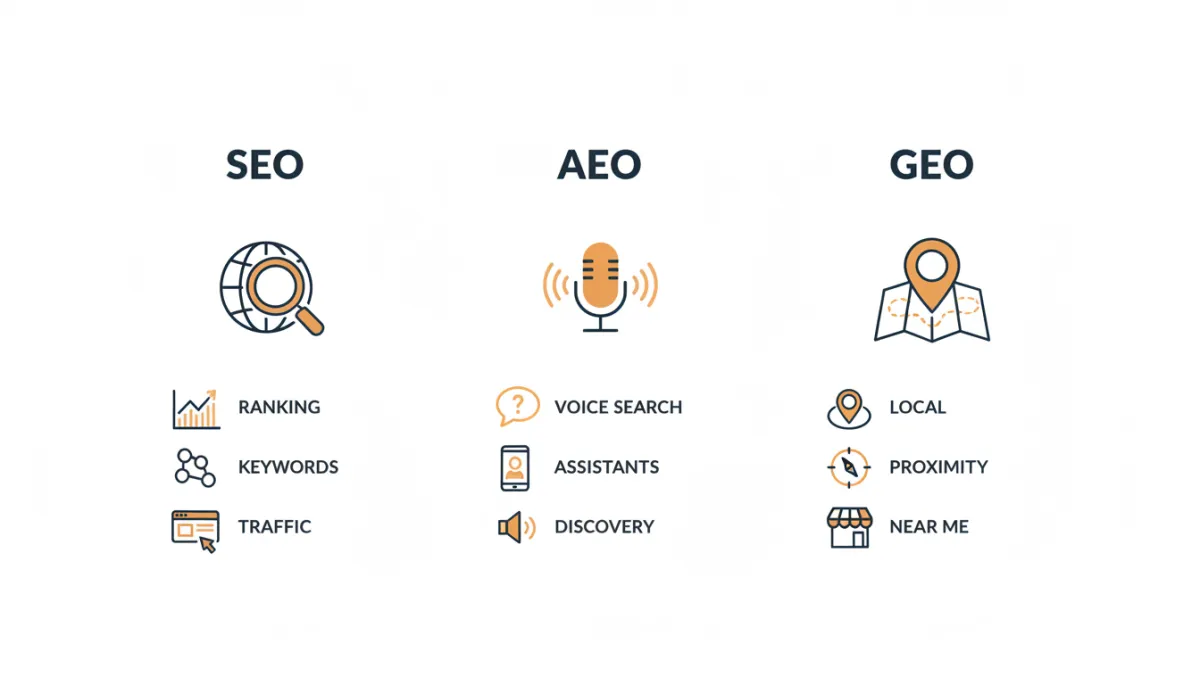
Treat GEO as the top layer that builds on solid SEO and AEO foundations.
💡 Pro Tip: You don’t choose between SEO, AEO, and GEO. The smartest small businesses align all three so they rank, get featured, and get cited by AI.
How AI Engines Like ChatGPT, Perplexity, and Gemini Decide What to Cite
When a user types or speaks a question—“What is generative engine optimization?” or “Best Latino accountant in Orlando?”—AI engines don’t just run one simple search. Behind the scenes, they break that question into many smaller searches, scan dozens or hundreds of pages, and then generate a single, coherent answer. During this process, they must decide which sources deserve a visible citation.
1. Relevance to the User’s Intent
First, AI systems evaluate whether your content actually answers the question. If someone asks “What is GEO?” they want a clear definition, not a vague sales pitch. Generative engines favor pages that:
Use the same language as the user (for example, “generative engine optimization” and “GEO”).
Provide direct, concise definitions or step-by-step explanations near the top of the page.
Cover related subtopics in depth, such as GEO vs SEO vs AEO, or local SEO examples.
2. Authority and Trust Signals
Multiple studies show that AI systems heavily favor sources they see as authoritative. That often means:
Strong backlinks from reputable sites in your industry or region.
Consistent information about your business (name, address, phone, services) across the web.
Clear author expertise—such as content written by recognized specialists like Moises Rivera at Impulso Digital Latino.
Research on AI search shows that generative systems often cite different sources than classic Google results, with very low overlap. They lean toward sites that have strong “entity” signals—consistent mentions and context across many platforms. For a small business, this means your brand story, services, and location must be clear and repeated in trustworthy places online.
3. Structure and Machine-Readable Clarity
AI engines love structure. They can understand messy text, but they prefer content that’s organized and easy to parse. That includes:
Descriptive headings that match user questions (for example, “What Is GEO?” or “How to Optimize for ChatGPT and Perplexity”).
Short answer blocks (40–60 words) that can be quoted as-is.
FAQs, bullet lists, and step-by-step processes that map closely to how people ask questions.
4. Freshness and Multi-Channel Presence
AI search systems also look at whether your information is current and supported across channels. With more than half of web traffic now coming from AI agents, visibility isn’t just about your website. It’s also about:
Updated Google Business Profile and local SEO listings for your Orlando area.
Active social profiles and review sites that confirm what your website says.
Content on platforms AI frequently reads, such as blogs, YouTube, and Q&A sites.
📌 Key Takeaway: GEO is about helping AI engines quickly recognize your business as relevant, trustworthy, well-structured, and consistent across the web.
7 GEO Strategies Any Small Business Can Implement Today
You don’t need a huge budget or a technical team to start with generative engine optimization. These seven practical steps are designed for small businesses and Latino entrepreneurs who want to get found by AI search engines this year.
1. Create Clear Answer Blocks for Key Questions
Make a list of the top 10–20 questions your ideal customer asks. Examples:
“What is GEO and why does it matter for small businesses?”
“Best Latino marketing agency in Orlando for local SEO.”
For each question, write a 40–60 word answer in simple English at the top of a dedicated page or section. This is classic AEO—and it’s the foundation of GEO. You’re giving ChatGPT, Perplexity, and Gemini a perfectly packaged paragraph they can quote and cite.
2. Use Natural Language and GEO Keywords Together
Generative engines are trained on real conversations. They favor content that sounds like how people actually talk. Combine that natural tone with strategic keywords:
“what is generative engine optimization” and “GEO” in your headings and intro paragraphs.
“AI search optimization,” “answer engine optimization,” and “optimize for ChatGPT and Perplexity” in relevant sections.
Local phrases like “Orlando Latino business,” “small business in Orlando,” or your specific neighborhood.
The goal is to help AI connect your brand with both the topic (GEO, AEO, AI search) and the location (Orlando, Florida) without sounding robotic or forced.
3. Strengthen Your Local SEO Foundation
GEO doesn’t replace local SEO—it builds on it. For AI engines to trust you as a local business, your basic signals must be rock-solid:
Claim and fully optimize your Google Business Profile with accurate categories, photos, hours, and services in English and Spanish if relevant.
Ensure your name, address, and phone number match exactly across your website, social media, and directory listings.
Encourage happy customers to leave honest reviews mentioning services and location (for example, “best Latino tax preparer in Orlando”).
When ChatGPT or Gemini scan the web, this consistency tells them: “This is a real, established business in Orlando that people trust.”
4. Build Topic Clusters Around Your Expertise
Modern AI search doesn’t just look at single pages. It looks at how deeply you cover a topic. This is where topic clusters come in—a central “pillar” article supported by related, more specific posts. For example, Impulso Digital Latino’s AI Search & AEO cluster might include:
A pillar guide: “What Is GEO (Generative Engine Optimization)?”
Supporting posts: “What Is AEO?”, “How to Optimize for ChatGPT and Perplexity,” “Local SEO Guide for Orlando Businesses,” and more.
For your business, think in terms of your services. If you’re a Latino-owned accounting firm, create a cluster around “tax help for small businesses,” with posts on bookkeeping, sales tax, and Florida-specific rules. Link these pages together. AI engines see this as topical authority, which increases your chances of being cited.
5. Show Real-World Proof and Case Studies
Generative engines value content that includes data, examples, and outcomes. Instead of saying, “We do AI search optimization,” show what that means:
Short case studies: “How we helped a Latino restaurant in Orlando increase AI-referred bookings by 30%.”
Before-and-after metrics: improvements in local SEO visibility or AI citations if you’re tracking them with specialized tools.
These details give AI something concrete to work with. They also make your content more persuasive for human readers who land on your site from an AI recommendation.
6. Optimize for Multi-Language and Cultural Relevance
Many Latino entrepreneurs serve bilingual audiences. AI engines increasingly understand and generate content in multiple languages, but they still rely heavily on how you present your information. Consider:
Offering key pages in both English and Spanish, especially service pages and FAQs.
Using phrases your community uses, such as “negocio latino en Orlando” or “servicios para pequeños negocios.”
Highlighting your cultural understanding—photos, stories, and examples that show you truly serve Latino businesses, not just as a buzzword.
This combination of language and cultural relevance helps AI engines match you with users asking for “Latino business” support, both in English and Spanish.
7. Test Your Visibility in ChatGPT, Perplexity, and Gemini
Finally, don’t guess—test. Open your favorite AI search tools and ask the kinds of questions your customers ask. For example:
“Who are the best digital marketing agencies for Latino small businesses in Orlando?”
“What is generative engine optimization for small businesses?”
Check whether your business appears in the answer or the citations. If not, that’s your starting point. Over time, specialized tools will help track AI citations more precisely, but even manual testing gives you valuable insight into how ChatGPT, Perplexity, and Gemini currently see your brand.

GEO helps local entrepreneurs turn AI-driven discovery into real customers and revenue.
💡 Pro Tip: Set a monthly reminder to test your business visibility in ChatGPT, Perplexity, and Gemini using your key service and location phrases.
GEO for Latino-Owned Businesses in Orlando — A Local Advantage
Orlando is one of the fastest-growing cities in the United States, with a vibrant and expanding Latino community. That means more opportunity—but also more competition. The good news is that GEO and AI search optimization can give Latino-owned businesses a local advantage if you move early while many competitors still focus only on traditional SEO.
Why Orlando Is a Perfect Testbed for GEO
Orlando’s mix of tourism, local neighborhoods, and diverse communities creates a wide range of search intents. People ask AI engines about:
Restaurants and nightlife beyond the theme parks, including authentic Latino cuisine.
Professional services—lawyers, accountants, real estate agents—who understand Hispanic culture and language.
Community resources, from churches to business associations to networking events.
If your content is optimized for GEO, AI engines can surface your business when someone in another state—or another country—asks where to find Latino-owned services in Orlando. That’s powerful visibility you can’t get from local SEO alone.
How Impulso Digital Latino Approaches GEO for Local Clients
Working with Orlando-area clients, Moises Rivera and the Impulso Digital Latino team focus on three pillars:
Local SEO Excellence: Clean citations, accurate maps, strong reviews, and bilingual profiles that signal trust to both Google and AI agents.
AI-Ready Content: Educational articles, FAQs, and service pages that answer questions the way ChatGPT and Perplexity expect—clear, structured, and full of local context.
Latino-Centered Messaging: Stories, case studies, and examples that highlight the realities of running a Latino business in Orlando, from language barriers to community support.
This combination helps AI engines recognize not just that you’re a business in Orlando, but that you’re a relevant, trusted, culturally aligned choice for users specifically asking about Latino-owned or Spanish-speaking services.
Turning AI Visibility into Real-World Growth
Remember: GEO is not just about being cited. It’s about what happens next. When AI-referred traffic converts at roughly twice the rate of traditional search, every new citation can mean more phone calls, bookings, and walk-ins. To capture that value:
Make sure your website loads quickly and looks good on mobile—many AI users click through on their phones.
Keep your contact options simple: clear phone number, WhatsApp link, and easy booking or contact forms.
Reinforce trust with testimonials from other Latino entrepreneurs and local customers.
📌 Key Takeaway: For Orlando’s Latino-owned businesses, GEO is a way to turn your unique cultural strengths into a discoverability advantage in AI search.
Frequently Asked Questions about GEO
1. What is generative engine optimization in simple terms?
Generative engine optimization (GEO) is the process of making your content and online presence easy for AI tools—like ChatGPT, Perplexity, Gemini, and Google’s AI Overviews—to understand, trust, and cite in their answers. Instead of only trying to rank on page one, you’re trying to become the source AI chooses to reference.
2. Do I need GEO if I already do SEO and local SEO?
Yes. Strong SEO and local SEO are still essential, but they’re no longer enough on their own. In 2026, many customers never see the full list of search results—they only see the AI-generated answer. GEO builds on your existing SEO by focusing specifically on how generative engines read and cite your content. Think of it as the next layer of optimization, not a replacement.
3. How can I tell if AI engines are already using my content?
Start by manually testing. Ask ChatGPT, Perplexity, and Gemini questions related to your services and location, then check whether your business name or website appears in the answer or citations. Specialized “AI visibility” and “AI rank tracking” tools are emerging as well, reflecting a surge in interest around GEO and AI search optimization. Over time, these tools will make it easier to measure GEO results just like SEO rankings today.
4. Is GEO only for tech companies, or does it help regular small businesses?
GEO is especially valuable for regular small businesses—restaurants, salons, law firms, accountants, contractors, and more. When someone asks an AI, “Who should I hire?” or “Where should I go?” the answer often includes a handful of local options. If you run a Latino business in Orlando and want to be one of those options, GEO gives you a clear, practical path to visibility in AI search.


