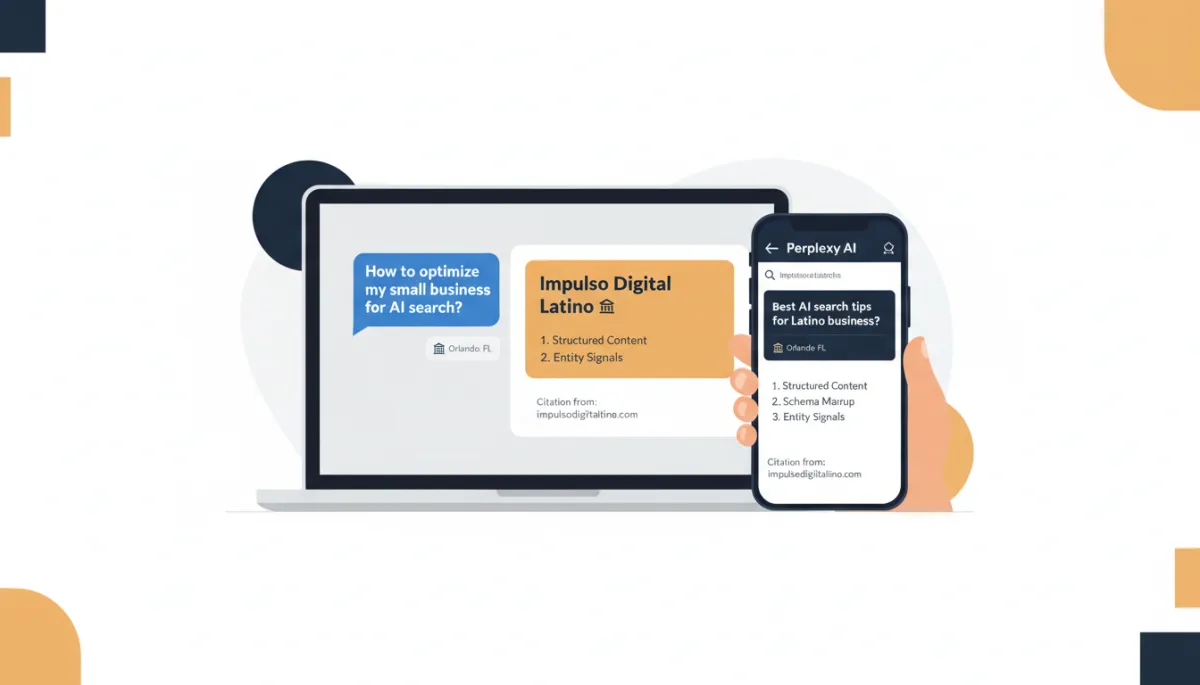
How to Optimize Your Business for ChatGPT & Perplexity
AI Search, GEO, AEO, Small Business Marketing
How to Optimize Your Business for ChatGPT and Perplexity
To optimize your business for ChatGPT and Perplexity, create clear answer-style content, add schema markup, keep your Google Business Profile complete, and maintain consistent business details across the web. These steps strengthen your entity signals so AI search tools can confidently cite your website, not your competitors.

Make Your Business the Answer in AI Search
Practical steps to appear in ChatGPT and Perplexity results
Why ChatGPT and Perplexity Are the New Search Frontier
Your customers are no longer typing only into Google — they are asking ChatGPT, Perplexity, and Gemini to “find the best Latino accountant near me” or “recommend a family restaurant in Orlando.” These tools summarize the web and return one main answer, often with a few citations. If you are not cited, you are invisible in that moment.
AI search engines behave more like assistants than lists of blue links. Instead of scanning ten websites, users receive a single, conversational response — with links treated as supporting evidence. That shift makes answer engine optimization (AEO) and generative engine optimization (GEO) essential for every small business, especially growing Latino businesses that depend on local discovery and trust.
Adoption is accelerating. Industry reports show millions of daily users on ChatGPT and rapid growth for Perplexity and Gemini. As these tools integrate into browsers and phones, they will influence where your customers eat, shop, and hire services. Moises Rivera and Impulso Digital Latino focus on helping small businesses anticipate this shift — not react to it later when competitors are already entrenched.
How ChatGPT and Perplexity Decide What to Cite
ChatGPT, Perplexity, and Gemini do not “crawl and index” exactly like Google. They generate answers using their training data, then look for live web pages to support those answers. While each platform is different, three core factors strongly influence which sites they cite: relevance, authority, and structure, all backed by clear entity signals.
Relevance: Does your page directly answer the user’s question in simple, natural language? AI search systems favor pages that match conversational queries — for example, “How much does a quinceañera photography package cost in Orlando?” — with clear, concise answers, pricing ranges, and local details.
Authority: Are you trusted across the web? Citations from respected sites, strong reviews, and mentions on local or industry directories tell AI models that your small business is a reliable source. This is classic SEO — but now it feeds AI search and answer engine optimization as well.
Structure: Is your content easy for machines to understand? Structured content, schema markup, and consistent entity signals — your name, address, phone, owner, services, and languages — help generative engines connect your business to specific topics, neighborhoods, and communities like “Latino business in Orlando.”
When those three areas are strong, ChatGPT and Perplexity can confidently say, “Here are the best options — and here is a trusted local business that fits.” Impulso Digital Latino designs GEO strategies that align exactly with these mechanisms, so AI search engines see your site as the obvious citation choice.
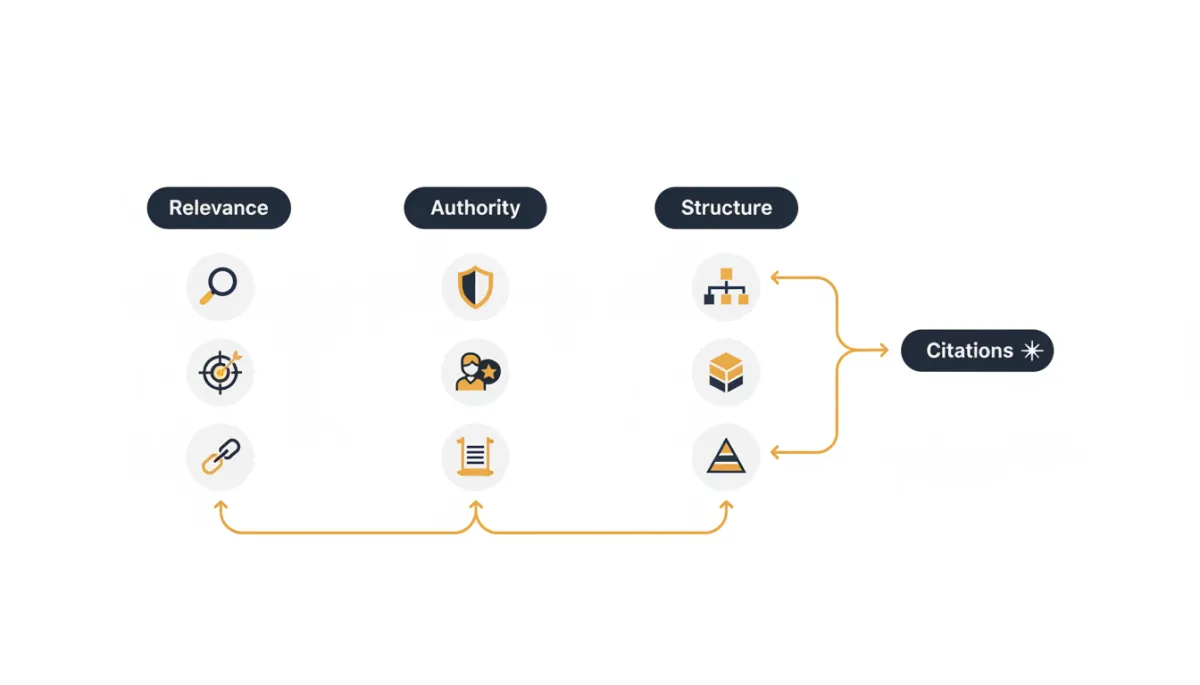
Relevance, authority, and structure work together to earn consistent AI citations.
6 Proven Strategies to Get Your Business Cited by ChatGPT and Perplexity
Build structured answer-block content on key pages
Treat your website like a source for AI search. For every important question your customers ask — pricing, services, guarantees, locations, languages — add a short, direct answer block near the top of the page. Use a clear question as a subheading and a 2–4 sentence answer immediately below. This mirrors how ChatGPT and Perplexity respond, making it easier for them to reuse and cite your content.Implement schema markup for FAQPage, LocalBusiness, and Person
Schema markup is behind-the-scenes code that labels your content for machines. For GEO and AEO, prioritize three types: FAQPage for your question-and-answer sections, LocalBusiness for your core business details, and Person for experts like Moises Rivera or your lead attorney, doctor, or consultant. You do not need to code this yourself — tools and agencies can add it — but having it in place significantly strengthens your entity signals for AI search.Establish entity consistency across the web
Generative engines pull from many sources. If your business name, address, phone, or website URL are inconsistent, AI systems hesitate to trust you. Audit your Google Business Profile, Yelp, Facebook, Instagram, chamber listings, and Latino business directories. Make sure the same spelling, accents, suite numbers, and phone appear everywhere. Consistent entity signals help ChatGPT, Perplexity, and Gemini recognize that all of those mentions refer to one strong, credible business — yours.Earn mentions on high-authority sites and directories
AI engines value the same authority signals as traditional SEO. Aim to be listed on respected local and industry sites — Orlando business associations, Latino chambers of commerce, professional organizations, and niche directories. Whenever possible, secure short profiles that describe what you do, who you serve, and where you operate. These citations and backlinks tell generative engines that your small business is part of the trusted ecosystem, not an isolated website.Publish bilingual content for broader entity coverage
Many Latino entrepreneurs serve both English and Spanish speakers. AI search tools do the same. Create key pages and blog posts in both languages — for example, “Orlando immigration lawyer for Latino families” and its Spanish equivalent. This bilingual strategy expands how your entity is understood, allowing ChatGPT and Perplexity to cite you for “Latino business in Orlando,” “abogado de inmigración en Orlando,” and related queries. Impulso Digital Latino specializes in aligning bilingual content with GEO best practices.Maintain an active Google Business Profile with detailed Q&A
Google remains a core data source for AI search. Keep your Google Business Profile fully optimized — categories, services, photos, hours, and attributes like “Latino-owned” and “bilingual staff.” Use the Q&A feature to publish concise answers to real customer questions. These Q&A entries act as structured mini answer blocks that AI systems can reuse, increasing your chances of being mentioned when someone asks for local recommendations through ChatGPT, Perplexity, or Gemini.
Local Edge — Getting Cited for Orlando and Latino Business Queries
Local intent is powerful. When someone asks an AI assistant for “the best pupusería in Orlando” or “Latino marketing agency for small business,” the engine looks for clear location and cultural signals. By combining local SEO with GEO, Impulso Digital Latino positions clients to surface in these high-intent, community-focused queries — not just generic national results that ignore local nuance.
Bilingual content, “Latino-owned” attributes, Spanish-language reviews, and mentions in Orlando and Central Florida directories all strengthen your local entity profile. For Moises Rivera and his clients, this is not theory — it is a practical framework for helping Latino businesses become the obvious answer when AI search tools look for trusted, nearby providers that understand the community they serve.
Where to Go Next with GEO and AEO
Optimizing for ChatGPT and Perplexity is not about chasing algorithms — it is about making your expertise easier to understand, trust, and cite. For small and Latino-owned businesses, that means combining solid SEO fundamentals with structured content, schema markup, and strong entity signals across every profile and directory. Start with your most important services and locations, then expand systematically.
If you want to see how this fits into the bigger strategy of generative engine optimization, Moises Rivera and the Impulso Digital Latino team have created a full beginner’s guide to GEO and answer engine optimization — written specifically for small business owners, not developers or data scientists.
Want to understand the full picture? Start with our beginner's guide: What Is GEO (Generative Engine Optimization)?
Also read: What Is AEO (Answer Engine Optimization) and Why It Matters Now — together, these resources show you how to optimize for AI search today while building a durable advantage for tomorrow’s ChatGPT, Perplexity, and Gemini updates.


